
An AI workflow for content operations at scale.
This study designs an AI agent pipeline for a content operations team: from brief intake through generation, review and publishing. Every human checkpoint is explicit. Every AI action is bounded.
Concept study — self-initiated, not a client commission.
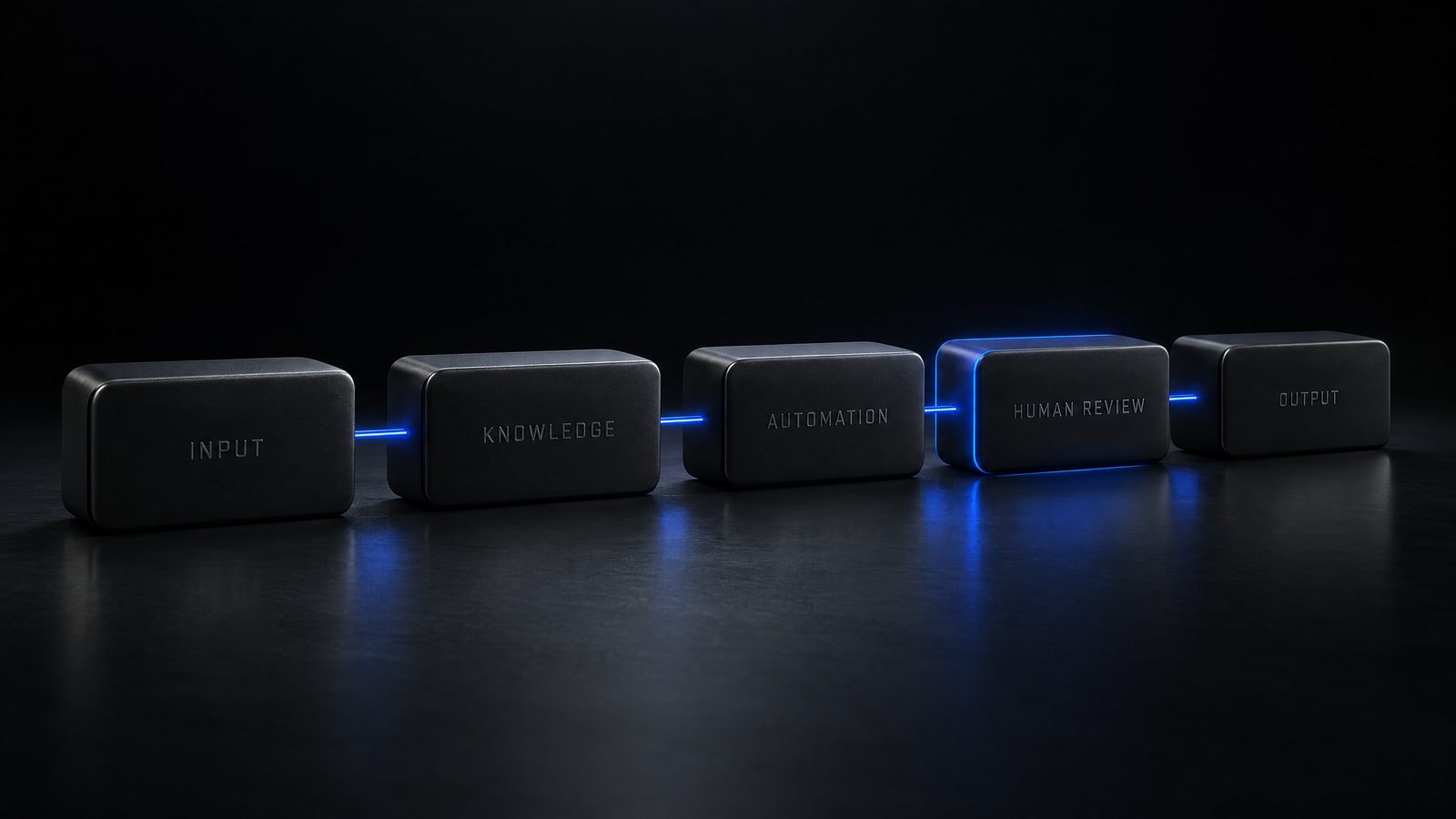
THE PROBLEM THIS EXPLORES.
Content teams that adopt AI tools often end up with faster output but lower consistency. The AI generates; a human edits; the brand voice drifts. This study designs a pipeline where the AI operates within defined constraints and humans review at the right points — not every point.
THE APPROACH.
Map the existing workflow
Before adding AI, document every step in the current content process: who does what, how long it takes, where quality breaks down. AI should replace the slow, low-judgment steps — not the ones that require brand knowledge.
Define the AI's scope
The AI handles: brief expansion, first draft generation, SEO metadata, internal linking suggestions, image alt text. The AI does not handle: brand voice decisions, factual claims, final approval.
Design the human checkpoints
Two checkpoints: brief approval (before generation) and draft review (before publishing). Everything between them is automated. The checkpoints are the constraint that keeps quality consistent.
Build the knowledge base
The AI needs a structured knowledge base: brand voice guide, approved terminology, topic clusters, competitor exclusion list. Without this, every generation is a lottery.
Define the failure modes
What happens when the AI generates off-brand content? When it hallucinates a fact? When the brief is ambiguous? Every failure mode has a defined recovery path before the pipeline goes live.
THE PIPELINE.
Brief intake
Human submits a content brief: topic, audience, goal, format, word count, deadline.
Brief validation
Agent checks the brief against the topic cluster map and flags gaps: missing audience definition, topic already covered, conflicting goal.
Brief approval
Human reviews the validated brief and any flags. Approves or revises. This is checkpoint one.
Research pass
Agent retrieves relevant internal content, competitor coverage and search intent data. Builds a context document.
First draft generation
Agent generates a first draft using the approved brief, research context and brand voice guide. Outputs structured markdown.
SEO pass
Agent generates title tag, meta description, slug, internal link suggestions and image alt text. Flags keyword gaps.
Draft review
Human reviews draft and SEO metadata. Edits for brand voice, factual accuracy and strategic fit. This is checkpoint two.
Publish preparation
Agent formats the approved draft for the CMS, applies internal links, attaches metadata and schedules the publish time.
Publish
Human triggers publish. The pipeline logs the content ID, publish time and brief-to-publish duration.
THE CONSTRAINTS.
What the AI is explicitly not allowed to do in this pipeline.
Make factual claims without a cited source in the research context.
Override a human decision at either checkpoint.
Generate content on topics flagged as competitor exclusions.
Publish without a human approval at checkpoint two.
Modify the brand voice guide or knowledge base without a separate approval workflow.
WHAT THIS STUDY FOUND.
The quality of AI-generated content is almost entirely determined by the quality of the knowledge base and the brief. A well-structured brief with a rich context document produces output that requires minimal editing. A vague brief with no context produces output that takes longer to fix than to write from scratch.
Field Notes
ONE USEFUL EMAIL A MONTH.
Practical notes on brand, websites, growth and AI from Numou AI.